

There is now an abbreviation for ‘In Real Life’, IRL, which tells you a lot about where we are as a society. We’ve gotten so accustomed to operating in digital space, that we now have a shorthand to remind ourselves that physical reality exists. And yet, here we meet, on a digital blog.
Are you about to open up a business?
There’s an online coach for that.
Are you specializing professionally?
YouTube has 47 courses for that.
Are you looking to find a mentor?
You can message anyone on the planet, and they’ll get back to you, even if they’re on vacation.
We have, by almost every measurable standard, never had better access to information, professional networks, or education. And yet, something genuinely valuable and irreplaceable is quietly slipping away.
IRL Professional Community
Actual rooms.
Actual people.
Occasionally, actual uncomfortable small talk over lukewarm mashed potatoes – while some drunk woman at an event walks by, dips her fingers into your potato plate, licks her fingers and smiles at you before walking away … Now it’s our collective PTSD.
No wonder in-person networking has become slowly and understandably optional.
What IRL Community Does For You
Research from Harvard Business School [pdf] has found that a strong in-person community significantly accelerates innovation. Being in physical proximity to curious, motivated, and driven people is a form of ‘social capital’ that is somehow quietly contagious.
People in tight nit communities also gain access to collaboration opportunities and pathways into leadership, which naturally enables you to turn social capital into financial rewards.
According to Lou Adler, CEO of Performance Based Hiring, 85% of work gets filled through professional community and personal relationships, not online job boards. That stat is worth sitting with for a moment. If the majority of opportunities move through connections, then in-person professional community shouldn’t be considered a personal preference or a soft skill. Not anymore at least. IRL professional community is infrastructure that silently pays royalties long after you’ve put the time into developing it.
Things Instagram Can’t Teach You
Here’s what tends to happen in an IRL room.
You hear about an idea, project, or a ticker symbol you hadn’t considered. Someone shares a mistake they made that saves you from making the same one two years from now. You see your own work from a slightly different, sometimes more honest, angle. You leave with something you couldn’t have Google’d, because you didn’t know it existed yet.
Psychologists have a name for what’s happening in those moments: knowledge spillover. The transfer of ideas, perspectives, and tacit know-how that only happens through proximity. You cannot subscribe to it, and you cannot download it. It moves person to person through unplanned conversations that don’t have an agenda item.
An online course can teach you a skill. And a good blog can sharpen your thinking. But serendipitous, slightly uncomfortable, occasionally breath-of-fresh-air professional collisions still require an actual room with actual people. Yes, even for those of us who’d genuinely rather be eating something we cooked ourselves at home. You gotta risk coat-check losing your $400 wool hat, and get in that room anyway.
Connection as Performance Enhancer
It genuinely pisses me off when I remember how the coat-check at Steamwhistle Toronto lost my hat. But I’m here to make a case for IRL community, so let’s talk about how it’s important from a health point of view.
Social connection has been found to boost longevity. The US Surgeon General’s 2023 Report [pdf] on social connection described loneliness as a public health crisis on par with obesity and smoking. According to Harvard Health, research that tracked over 28,000 elderly people over a 5 year period found that the more frequently a person socialized the longer they stayed alive. There you have it. The more in-person connection you have, the more years you are likely to live, which will allow you to continue contributing long after your peers have dropped away.
Social connection has also been found to boost cognitive ability. According to Harvard School of Public Health, social ties slow cognitive aging and are associated with slower memory decline in mid life. This means that showing up to a networking event without knowing anyone, cold-calling a prospect, or meeting for a coffee to discuss an opportunity is good for you. Think of it this way. Cold Call = Ice Bath for your brain. Longevity hack x2! Let’s go!
Connection as a Professional Asset
IRL community takes more effort than working quietly on your own. It requires showing up when you’re tired, creating conversation when it’s easier to check and respond to your emails, and investing time in relationships whose return isn’t guaranteed or always immediately obvious.
The ROI is real, however. It’s just on a longer timeline from the immediate gratification we’ve become accustomed to (likes, comments, follows). The research and anecdotal evidence point in the same direction: careers grow faster with IRL community. Skills matter. Hard work matters too. But the people you learn from, build alongside, and exchange ideas with tend to shape your trajectory far more than you expect, and usually more than you’re prepared to give them credit for.
Connection is the life blood of business. The simple economics of it is that every business runs on two things: people you serve, and people who serve you. That supply and demand equation doesn’t resolve itself, which is why entrepreneurs who can make those connections have the potential to earn 1000x more than a salaried employee. IRL professional community, if organized effectively, facilitate and bring together both kinds of people.
How to Show Up
- Go to one IRL professional event per month. One event. Lower the bar enough that you’ll be embarrassed not to check it off your to-do list.
- Start by talking to the person standing alone not wearing a black or blue suit. They’re also new here. You’ll both be relieved.
- Follow up with everyone who handed you their business card. One message.
- Join a board, a committee, or a recurring group. One-off events are fine, but recurring community is where the real compounding happens. Show up consistently enough that people stop having to remember your name for the first time.
Moving from Attendee to Architect
Most people assume networking is binary: you network or you don’t. But the reality is more layered, and more consequential. There are levels of participation, and each level quietly compounds, or limits, your access to opportunity.
You can sit at the edge of the room, quietly consuming what others are saying. You can step forward and build connections. Or you can move further still, shaping rooms, creating gravity, and becoming someone others orient around. The difference isn’t talent. It’s posture.
The levels of IRL Community Participation look like this:
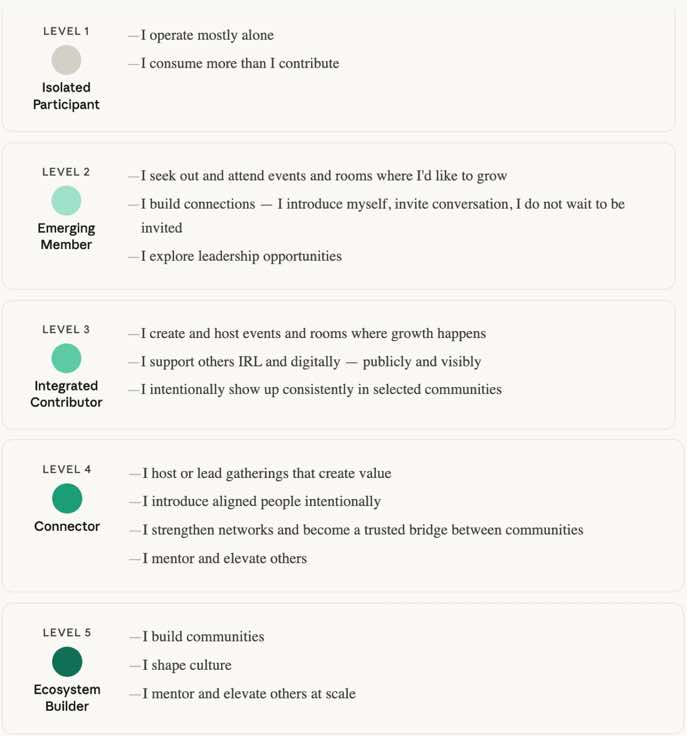
According to my Personal Growth Excel Spreadsheet … yes, I made one specifically for professional community, and yes it does hold me accountable … I am working towards being an Ecosystem Builder. How about you?
The bottom line
No meaningful career is built entirely alone. It’s built alongside a IRL professional community.
The question isn’t whether you need this. It’s whether you’re willing to put your socks on, eat lukewarm mashed potatoes, have Steamwhistle event coat-check lose your expensive woollen hat, have a lady you don’t know stick her fingers in your food, and still keep showing up.
Now go.
Participate.
The IRL professional community is waiting for you.
On the other side: growth, brain health, friendship, longevity, shock therapy, money, and some fond memories await you.
Aneta Kosinska is a Polish – Canadian, MSc + CEMS MIM alumni. With management consulting, analytics and startup/entrepreneurial experience, she aspires to contribute to the knowledge sharing economy.
Image: Youtube, Aneta Kosinska
🔴 Found these ideas useful?
Sharpen your edge