
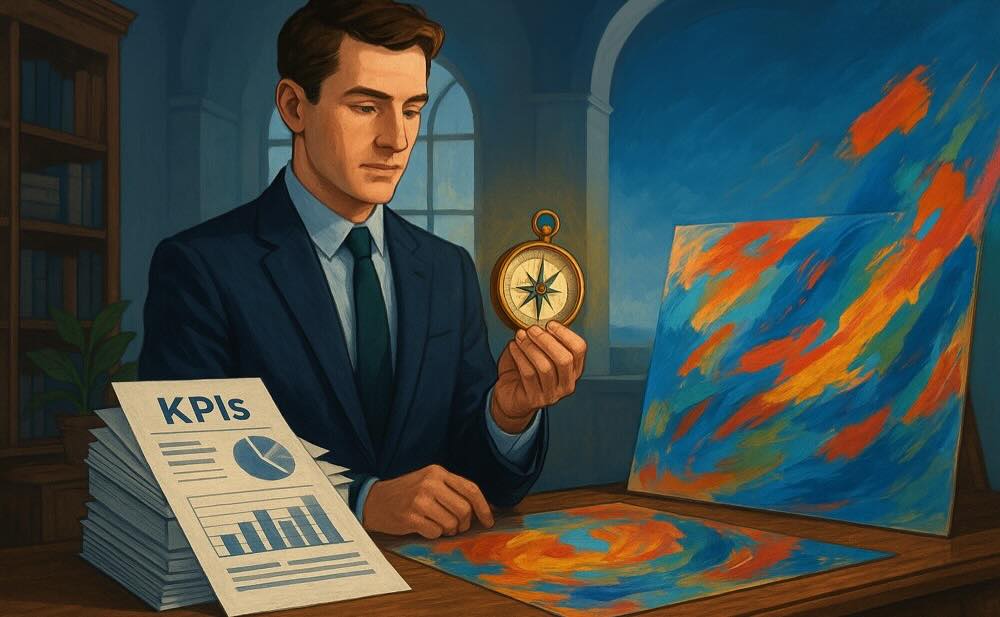
As I get older, life starts looking less like a well-laid-out blueprint and more like a toddler’s finger painting: unpredictable, bizarre, and somehow still deeply meaningful.
It’s basically a big blob of nothing and everything, depending on how you choose to look at it.
It can also shape-shift. People can fall, even though everyone thought they had the power. And others can rise, even when everything seems stacked against them. And in the in between, somehow we’re all still always growing … hopefully upwards.
There’s also no final draft to it, nor tidy conclusion. And definitely no omniscient manager sitting in a swivel chair giving you a performance review, unless you of course count your inner critic.
If businesses have KPIs, how can we measure performance in the messiness of life that we are each working in?
Values as Life’s KPIs
They’re not posted on a whiteboard in an open-concept office with words like “synergy” and “impact” written in Comic Sans. They’re more subtle. Typically felt in the gut. And recognized only when you’ve either upheld them or betrayed them. And the reward is not money or a promotion, but instead a deep sense of peace, alignment, and a strange, unshakable, clarity.
So what are values, really?
I’ve come to understand that values are just boundaries with a luxury watch on. They’re the things you won’t tolerate, flipped in reverse.
For example, if you hate it when people tell you one thing and do the opposite, integrity is probably high on your list of values. If you can’t stand people flaking, maybe you value commitment. Enforcing boundaries can come out sounding a bit grumpy: “I can’t stand people who arrive late”. But living up to your values sounds more life affirming: “I believe in punctuality”.
I spent a good chunk of my twenties in management consulting. You know … the land of sharp suits, sharper decks, and devotionally tracking KPIs.
What I loved most about the world of management consulting was that it’s case-based. You get assigned a project, which has a beginning, a messy middle, and an end. You dissect the issue, identify pain points, solve for X, and call it a day.
It’s chaotic. But it’s structured chaos. And that’s relieving. At least for me it is.
My time in it taught me something super valuable: to thrive in its chaotic uncertainty, I needed to find a way to navigate it that kept me in congruence: mind, heart, and soul. Which is why I personally grew to love retrospectives (hold the nerd comments).
There always came a moment at the end of a project when we’d all sit down and say, “Alright. What worked. What didn’t. And how do we never end up in that hell hole again?”
And if worked through with camaraderie and humility, retros became rocket fuel for growth and connection. There’s a German saying, “Man sieht sich immer zweimal im Leben!” It translates into something like “you meet the same person twice.” This can be taken positively as though to say in life “you will see the person again”, or in the way that I resonate with it: “life might send us someone new, who carries the same old pattern. And unless we’re aware, we risk replaying the same story with a different character.”
In life, not everyone’s working on the same project as you. So how do you manage?
In my opinion? You run a life retrospective as major phases or experiences come to a completion. And it works!
Here’s the framework:
- Write down what happened. Just the facts. No adjectives. No “he was such an X” or “I was so X.” Just write the timeline, the events, clean and clear.
- Label the emotions afterwards. Go through the facts one line at a time. And allocate one emotion to each fact, one line at a time. That’s all. What you’re doing in this exercise is separating the facts from the emotions.
When you separate what happened from how you felt about it, you stop staring at that one tree whose leaves were swaying really fast and loud in the wind. And instead, you start to notice the entire forest you were walking through and how far you’ve come. You see the experience more clearly.
You also see the patterns, the blind spots, and you might even notice moments where you didn’t take a stand for your values. And then, you get to decide what to do next, without the fog of emotions disguised as facts. And this feels motivating, because it’s clean and action oriented. In life, you are both the analyst and the asset, the consultant and the client. You’re the one writing the report and living the outcome.
I recently ran the numbers on a life moment that had me spinning. I went full papers on the ground, multi-colored-pens out, and the framework above. And what emerged was pure clarity. It honestly was a defining moment that helped me see not only the situation, but myself too. I spotted the moments I stayed quiet when I could have spoken up. And the times I crossed my fingers hoping for the best instead of trusting the patterns. I clocked it all. But here’s the cool thing to notice: the faster I can spot the patterns, the faster I can reroute, and the more I can stay aligned to my values. That’s the real game-changer.
We don’t need more external feedback. We need inner KPIs that are actually ours. Because in work, the results are outside you. But in life? You are the work.
Study after study says that true winners are the ones that reach for and sustain success, emotional and mental well being, and positive relationships for the long run. Both at work and in life.The ones who can move through uncertainty, manage the waves, and stay values-aligned even when it’s really hard … Keep. Moving. Forward.
Through trial and error, winners have learned an inner confidence that allows them to navigate the terrain without losing themselves. No matter how messy it gets.
So here’s my ask to you: next time life throws you a curveball (because you know it will), treat it like a case study. Map the facts, write out the timeline, and label the emotions. Let the patterns emerge.
Then ask: What did I take a stand for? And if I were to be even more devoted to my values, what would that look and feel like in the future?
If you have ever wondered how to build confidence in life, ever desired to be a congruent respected leader and friend, ever wanted to create something you see in your minds eye, start here:
Build an internal valuation system: values as KPI’s.
Root yourself in self awareness, reroute your actions with your values, and become relentlessly devoted to creating life from where you stand right now. That’s the entrepreneur’s edge. In the board room, and in the room of life.
Aneta Kosinska is a Polish – Canadian, MSc + CEMS MIM alumni. With management consulting, analytics and startup/entrepreneurial experience, she aspires to contribute to the knowledge sharing economy.
Image: Youtube, Aneta Kosinska
🔴 Found these ideas useful?
Sharpen your edge