
Economic growth isn’t leading to prosperity for all

It is a truth universally acknowledged, that a society in pursuit of prosperity must be in want of a larger economic pie.
When the economy grows, businesses produce more goods and services and generate more profit for shareholders. Individuals have more employment opportunities and can bargain for higher wages. Income is plentiful, and as governments clip the ticket they are able to collect more tax revenue to fund more and better public services.
Growth is an unquestioned good.
With the exception of a short-lived recession during COVID, Australia has enjoyed rising economic output for more than 35 years.
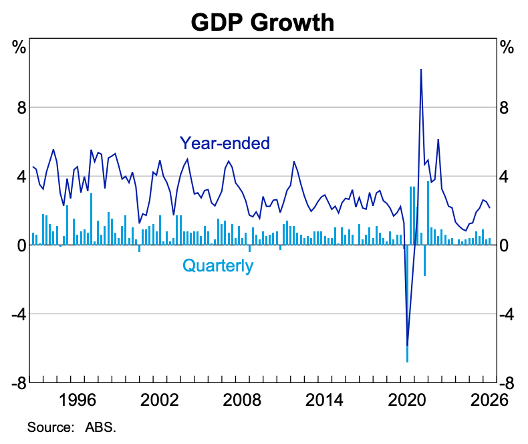
Why then do many Australians feel like they are falling behind?
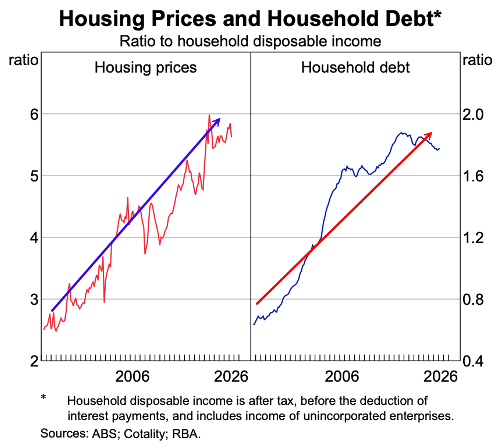
Well, for starters, house prices have risen to eye watering levels that make home ownership increasingly unattainable for younger generations. When your author’s parents were young, the average house price was around 2.5 times the average income. Today, it is more than 5.5 times the average income. This means that individuals have to take on larger mortgages to become property owners, which has seen the household debt ratio more than double over the last four decades.
More recently, the RBA has increased the cash rate to its highest level in 15 years.
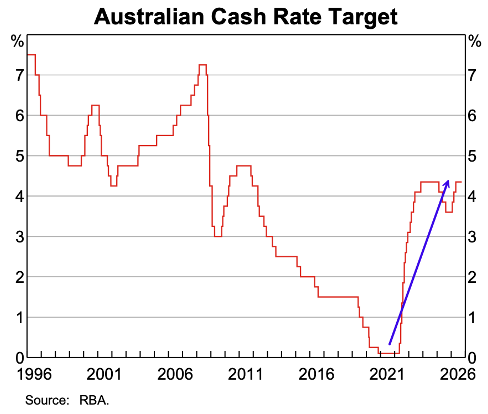
Higher interest rates negatively impact household finances in several ways. Firstly, higher interest rates combined with high household debt levels translate into much larger interest payments, which reduce household disposable income and living standards. Secondly, higher interest rates reduce household borrowing capacity, making it harder for young families to buy their first home, leaving them trapped in renter’s purgatory. Thirdly, as lower borrowing capacity puts downwards pressure on house prices, existing homeowners experience falling net worth. This hits recent home buyers the hardest, and especially those who got suckered into the Australian government’s 5% deposit scheme. As households see their wealth decline, consumer confidence starts to evaporate, leading households to tighten their belts, and as economic activity declines further across the board, businesses postpone investment projects and freeze new hiring, which reduces employment opportunities and the level of national income.
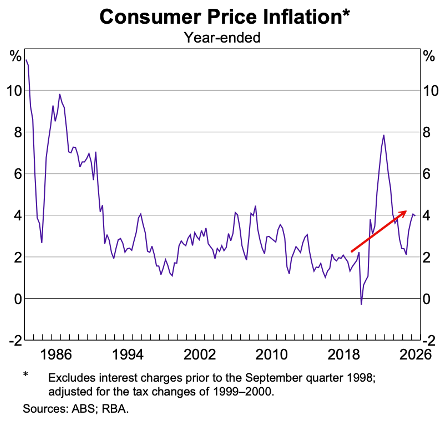
To add insult to injury, households are also grappling with a cost of living crisis. Inflation hit 7.9% in late 2022, and following a temporary dip in late 2024 and 2025, it continues to hover above the RBA’s 2-3% target. With Treasurer Jim Chalmers continuing to spend like a drunken sailor, and the price of oil continuing to be impacted by shipping disruptions in the Strait of Hormuz, inflation risks remain to the upside.
Despite the massive gap up in house prices in recent decades, the advice from the boomer generation has remained remarkably stable, ‘save for a deposit, get onto the property ladder. If we could do it, you can too’. The numbers suggest that many young people are following this well-intended albeit increasingly out of touch advice. Around one in five 25-29 year olds now live with their parents, compared with around one in ten in the early 1980s. While living with mum is not necessarily a negative, and although money is not everything, lower levels of financial and personal independence are definitely considerations for young people when deciding whether to get married and start a family. In 1971, the median woman was married by the time she was 21 years old. Fast forward to today, and the median woman doesn’t get married until she is in her 30s.
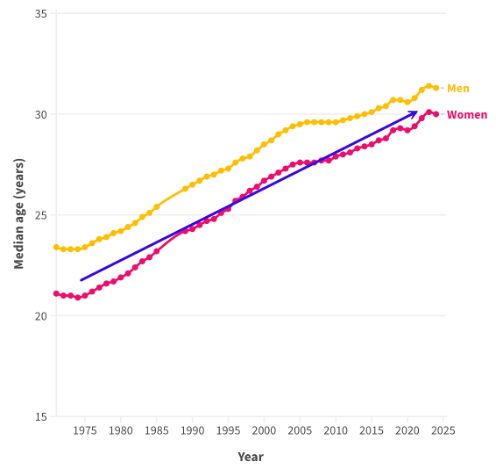
Source: Australian Inststitute of Family Studies
Delayed family formation is often painted as a positive. Individual freedom is a good thing, and so delayed marriage and parenthood are also viewed as good things as they reflect greater freedom to choose one’s own career or life path. However, this assumes that young people, who have never been middle aged or elderly, have the ability to make choices that reflect their own long-term best interests. It also assumes that delayed family formation reflects individual preferences, rather than a response to tightening economic conditions that prevent people from leaving home and building a family of their own.
However you spin it, a society in which young people can’t afford to build families is a society that is, in a real and fundamental sense, experiencing less prosperity. Delayed family formation has contributed to the average family having fewer children. The replacement fertility rate is roughly 2.1 children per woman, which is needed to maintain a stable population across generations without resorting to immigration. In 1971, Australia’s fertility rate was 2.9, which reflected a naturally growing population. Today, the fertility rate is less than 1.5.
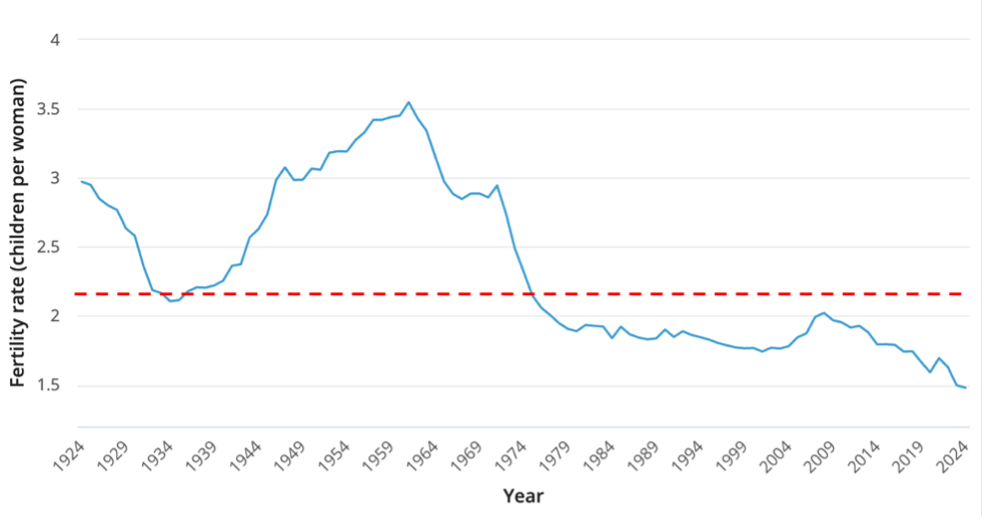
Source: ABS
The most immediate effect of low fertility rates is a gradually aging population, with a smaller proportion of young people.
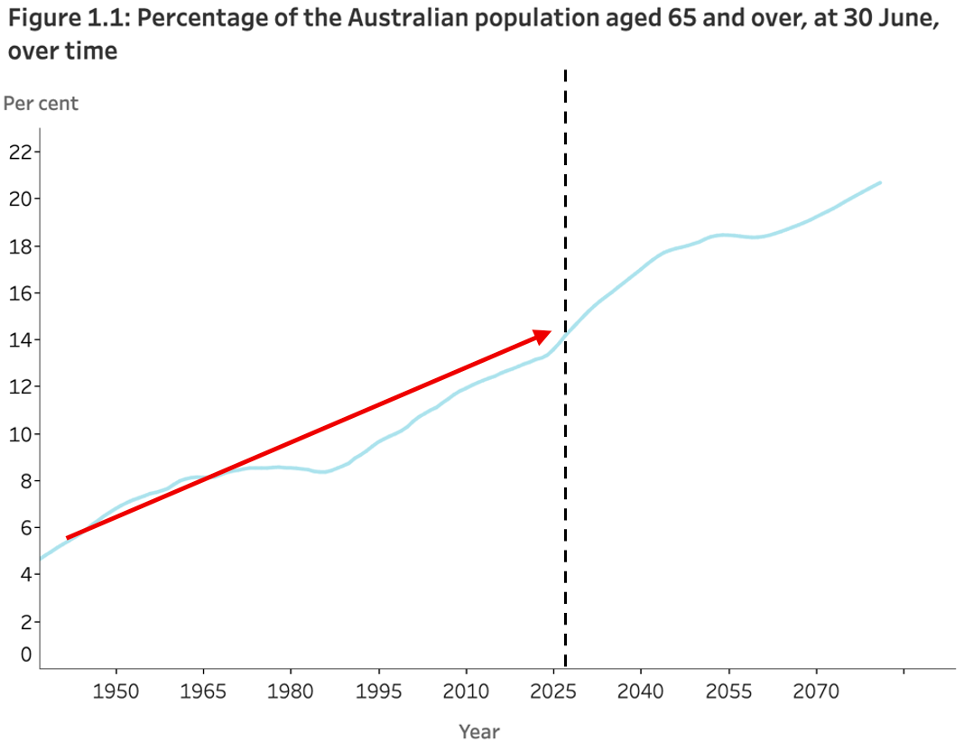
Source: Australian Institute of Health and Welfare
An aging population will lead over time to labour shortages and strain on social welfare programs, such as the age pension, which are paid for from personal income taxes. If fertility remains below replacement, Australia’s population will naturally decline.
To plug the gap, successive Australian governments have turned to immigration. Migrants can bring much needed skills, increase the labour supply, and pay income taxes to support Australia’s ageing population. However, if population growth outpaces investment, immigration can also lead to capital shallowing. This means that the average worker has less capital at their disposal, and becomes less productive. Immigration can also increase demand for scarce resources, such as housing, schools, and essential public services like public transport and hospital beds.
This creates a rather uncomfortable paradox.
Australia relies on immigration to offset declining fertility rates, and yet the resulting strong population growth can make it even harder for young Australians to build families of their own.
The bottom line
Economic growth is no bad thing. Over the long run, more economic output means increased employment opportunities, reduced poverty, and rising living standards.
The catch is that a bigger economy is not necessarily a more prosperous one.
If rising output and national income are accompanied by unaffordable housing, rising debt levels, declining financial independence, and insurmountable obstacles to family formation, it is reasonable to question whether the benefits of economic growth are worth the costs.
The Australian government has succeeded in growing the economic pie, but has forgotten to ask or care whether the average true blue Aussie ocker is still getting her fair share.
Image: DALL-E
🔴 Found these ideas useful?
Sharpen your edge in consulting