
Why economic growth may not lead to human wellbeing

It is often said that a bigger economic pie can make everyone better off. After all, what’s not to like about more pie?
In the previous two articles, we explored why growth does not necessarily make people better off, and how productivity can drive sustainable growth.
However, the size of the pie is only part of the story. We also need to consider how the pie is sliced, what each slice can actually buy, the hidden costs of baking the pie, and who controls the bakery.
In other words, the benefits of growth depend not only on how much income is generated, but on who receives it, what it can buy, and what is given up in the process.
1. Distribution – Some people get a bigger slice
Economic growth generates additional income for workers, landlords, business owners, banks, and the government, but some groups capture more than others.
History provides a gruesome example. When the Black Death swept Europe in the fourteenth century, it killed every second person in many regions. In the aftermath, vast swathes of farmland lay uncultivated. The workers who survived, by the grace of God, were highly sought after. Labour was scarce, while land was plentiful. As a result, workers gained bargaining power and real wages rose [pdf], while landowners found themselves receiving lower rents. Although the economic pie had become smaller, the surviving workers often enjoyed higher real wages as their slice of the economic pie grew.

Source: Microbes and Markets: Was the Black Death as Economic Revolution? by Gregory Clark, UC-Davis
In more recent times, the opposite trend has occurred in America. In the decades following the Second World War, labour productivity and real wages rose in tandem. Since 1971, however, real wages have fallen far behind productivity gains.

Sluggish real wage growth can be understood by looking at the supply and demand for labour. Immigration has massively increased the supply of labour. Since 1970, America’s foreign-born population has increased by more than 40 million. At the same time, offshoring of production and import-competition from Chinese firms have reduced the demand for American workers. Together, these factors have contributed to real wages growing more slowly than productivity. However, one man’s feast is another man’s famine. Lower labour costs have increased the profitability of American firms, with owners of capital seeing their share of national income rise by more than 16% since 1971.
Income inequality in America is on the rise. Since 1971, America’s Gini coefficient, which measures inequality in the distribution of income, has increased from 0.37 to 0.42.

According to the World Bank, inequality in America is now higher than various war torn countries like Iraq, Syria, and Lebanon. At first glance, this is surprising. However, it is less puzzling when you realise that greater equality does not necessarily mean greater prosperity. In countries devastated by war, corruption, or financial collapse, citizens may be more equal simply because everyone is equally poor. To misquote Winston Churchill, “The inherent vice of capitalism is the unequal sharing of blessings. The inherent virtue of basket-case economies is the equal sharing of miseries.”
The inherent vice of capitalism is the unequal sharing of blessings. The inherent virtue of basket-case economies is the equal sharing of miseries.
Rising income inequality also has implications for the distribution of wealth. High-income households are able to acquire more productive assets, allowing them to generate more income, which can then be bankrolled into further asset purchases, enabling them to compound more wealth over time. Since 1990, the share of financial assets held by the richest 1% of Americans has increased from 25% to 36%.

As the rich get richer, younger households are struggling just to get a foot on the ladder of prosperity. In 1990, the median first-time homebuyer in America was 30 years old. Today, they are over 40.
Rising inequality does not necessarily mean that lower-income households are becoming poorer in absolute terms. In theory, everyone’s slice of the pie can grow, even if the biggest slices are growing faster. However, persistent and rising inequality raises serious questions for economists and policymakers.
- Does everyone still have an opportunity to contribute?
- Is it actually a problem if some people earn a lot more than others?
- Could existing income redistribution efforts by government be more effective?
- Do religious groups and private charities have a greater role to play in tackling inequality?
2. Scarcity – Higher incomes can lead to bidding wars
Economic growth often leads to improved living standards. Sustainable economic growth is driven by rising productivity, which enables firms to produce more, often with fewer resources. This allows firms to lower prices, which is the story of most mass produced consumer goods. For instance, the price of TVs (adjusted for quality) has fallen by around 98% since 2000. More productive workers are also more valuable, enabling them to command higher wages. The combined effect of higher incomes and lower prices is improved living standards.
However, rising prosperity can also push up prices of certain highly desirable goods. Things like places at prestigious private schools, luxury handbags, or front row tickets. If a good is scarce, supply doesn’t expand much in response to rising demand. As incomes rise, people are able to pay more, which just leads to higher prices. For instance, housing in safe neighbourhoods near desirable schools is in short supply. Your grandparents who worked in the post office may have purchased a quarter acre block near the local school for three packets of blueberries. Today, that same house at auction may be attracting bids from bankers, lawyers, and management consultants.
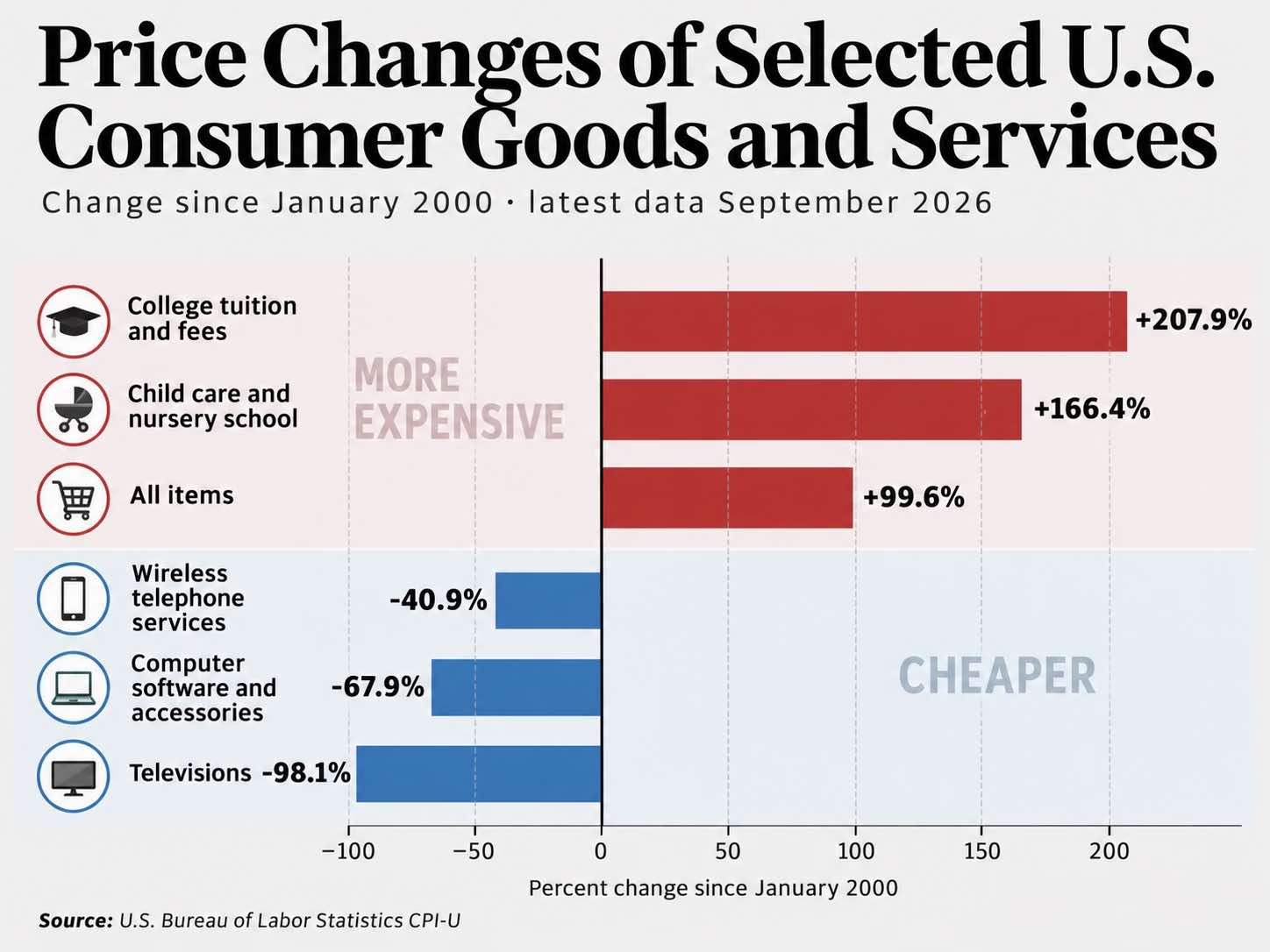
Rising prices also have implications for the distribution of wealth. Rising house prices, for instance, benefit the navel-gazing boomer generation of existing homeowners, while first-time buyers have to borrow eye-watering sums just to find a place to shelter their young children. Higher incomes may be largely swallowed up by higher housing costs, leaving the average household with more debt and no real improvement in living standards.
Ultimately, rising productivity can lower the price of ordinary consumer goods, but it cannot allow everyone to own waterfront property. Rather than everyone becoming better off, rising incomes can lead to bidding wars for the most desirable goods.
3. Hidden Costs – When more becomes less
Producing more goods and services can make society better off, as there is more to go around, but it can also impose costs that are not reflected in GDP. One such cost arises from negative externalities, which occur when producing or consuming goods and services imposes costs on people who are not directly involved.
Consider the growing popularity of electric vehicles. Producing EVs contributes to GDP, generates income for workers, virtue for politicians, and promises to reduce CO2 emissions. However, while EVs offer consumers cleaner transport, producing them also imposes hidden environmental and human costs. The batteries for these cars require huge quantities of cobalt, which is primarily mined in the Congo where mining activities often pollute local waterways. These costs are not necessarily reflected in the price of the vehicles, and are disproportionately borne by the poorest communities thousands of miles away.
Another hidden cost arises when producers exploit a resource that lacks clearly defined property rights. Economists call this the tragedy of the commons. Fishermen, for instance, have an incentive to catch as many fish as they can. However, if everyone behaves this way, fish stocks can collapse, leaving fishermen out of work and sashimi loving consumers out of luck.
In many cases, economic activity can increase GDP while imposing hidden costs on the environment or the wellbeing of local communities.
4. Control – Who runs the bakery?
If a firm has monopoly power it may be able to dominate its market and capture a large slice of the income. This is evident in the tech sector, where companies like Meta, Apple, Google, and Amazon (MAGA) benefit from huge barriers to entry, making it costly for new firms to enter, and allowing them to operate extremely profitably. For instance, Apple enjoys formidable barriers to entry. Strong brand loyalty and large economies of scale allow it to sell larger volumes at lower unit costs. Apple also enjoys huge network effects. The large number of iPhones already sold attracts the best app developers, making iPhones even more valuable.
Large profitable firms are not necessarily a bad thing. Their success may be the result of many years of investment, successful innovation, and the creation of enormous value for consumers. Their high profits can also enable them to pay above market wages and invest ambitiously in innovation that may not otherwise happen. For example, Google’s investment in DeepMind helped to create AlphaFold, an AI system that has predicted the structure of more than 200 million proteins, and which are made freely available to scientists worldwide.
Issues arise when firms abuse their market power to the detriment of other groups in the economy. Predatory pricing can be used to drive competing firms out of the market. In the late 1800s, for instance, Rockefeller’s Standard Oil was accused of slashing prices to undermine independent oil refiners, helping it establish a near-monopoly of the American oil industry. Price gouging can be used to charge excessively high prices to consumers who have no real alternatives. In August 2015, for example, Martin Shkreli increased the price of Daraprim, a life-saving medicine, from $13.50 to $750 per tablet. Meanwhile, lobbying can be used to influence regulations to protect a firm’s already dominant position. For example, in 1998, Disney lobbied US Congress to extend copyright protection by another 20 years, just as its exclusive rights to Mickey Mouse were about to expire.
Growing the economic pie is one thing. Controlling the bakery is quite another.
The bottom line
Economic growth has transformed modern society, lifting billions out of poverty and delivering living standards that previous generations could not have imagined.
However, a bigger economic pie does not necessarily mean a better life for everyone. Much depends on how prosperity is distributed, whether extra income can buy the things people value, the hidden costs imposed on society, and who controls key markets in the economy.
Ultimately, growth is a means to an end, not an end in itself. The challenge is to ensure that higher productivity translates into greater human wellbeing. After all, it’s not the size of the pie, but what you do with it.
🔴 Found these ideas useful?
Sharpen your edge in consulting